


Young Human Chondrocytes expansion in the Quantum® Hollow-Fibre Bioreactor
Charlotte Hulme, John Garcia, Claire Mennan, Robert Freeman, Nigel Kiely, Derfel Williams and Karina Wright
Funded by the Medical Research Council.
We are working to develop new treatments that can help repair damaged joint cartilage. Cartilage doesn’t heal well on its own, and current treatments often rely on using a patient’s own cells, which can be slow, expensive and not always successful. Our goal is to create an “off‑the‑shelf” cell therapy, using donated cells, that could be ready to use when patients need it.
To do this, we need to grow very large numbers of healthy cartilage‑forming cells, called chondrocytes. We use a special machine called the Quantum® bioreactor (see picture insert 1), which acts like a highly efficient cell‑growing chamber. It provides a huge surface area for cells to grow, allowing us to produce far more cells than traditional lab methods. Other benefits of this system include the fact that it is completely automated and enclosed, in the future supporting reduced manufacturing costs and lowering the risk of contamination.
We first tested the system using cartilage cells from adults having knee replacement surgery. These cells grew well, and we were able to produce around 86 million cells in just over a week, while keeping their ability to form new cartilage.
We then explored whether donor cells from young children, whose cells have a better ability to form cartilage, as part of the natural aging/growing process, might be an even better option. With full consent, we collected small pieces of cartilage from routine surgeries, such as the removal of extra fingers or toes (polydactyly; see picture insert 2) or from hip procedures in young children.
These juvenile cells grew well in the Quantum® system, with similar total numbers of cells to the standard method, but the cells grew more slowly in the bioreactor. Importantly, the cells kept their normal cartilage‑cell features, including the markers they express on their surface. They also kept their ability to form new cartilage‑like tissue, producing key molecules needed for healthy cartilage. This work is very promising for the development of new off-the-shelf therapies, and was recently shared with the scientific community in a peer-reviewed publication. We have now been awarded some additional funding to further characterise these juvenile cells.
This work is an important step towards using donated juvenile cartilage cells in future treatments. These future treatments would be more accessible, more consistent and more cost-effective.
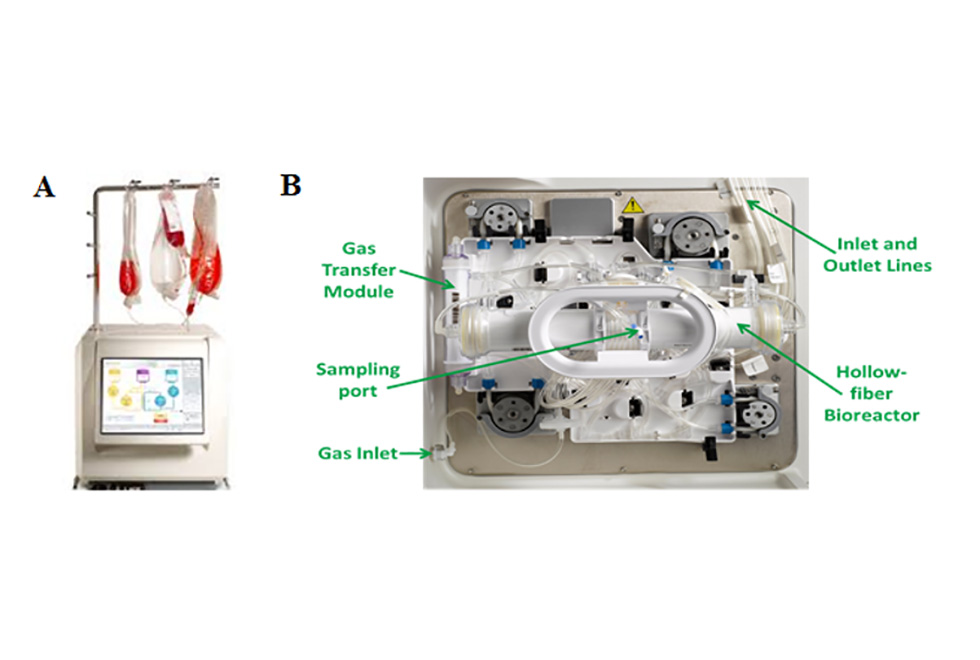
Figure 1. The Quantum® cell expansion system. A. Computerised incubator and control panel. B. Disposable hollow fibre bioreactor module composed of ~11,500 fibres.

Figure 2. Tissue grown from polydactyly donors in the Quantum® bioreactor